
 Business License

Powder-Coated Steel Bunk Beds for Budget Accommodation: Easy Assembly Solutions for Hostels
If you run a hostel, manage student housing, or handle dormitory procurement, picking the right bunk bed is one of those decisions that looks simple but bites you later.
The market has three options: wood beds, cheap painted steel beds, and powder-coated steel beds. Prices range from $50 to $150 per unit. The cheapest option upfront is rarely the cheapest over five years. The most expensive one upfront can save you real money if you know what you are doing.
This article walks through the math, the traps, and what actually matters for different accommodation types.
**What Powder Coating Actually Means**
Powder coating and regular paint are not the same thing.
Regular paint is sprayed on and air-dried. It sits on top of the metal. Knock it with a suitcase corner, and it chips. Leave it in a humid room, and it bubbles. Six months in a busy dorm, and you start seeing rust spots where the paint has fallen off. By year two, the bed looks worn even if the frame is still solid.
Powder coating works differently. The paint is applied as a dry powder, electrostatically charged so it sticks to the metal, then baked in an oven. The coating fuses with the steel surface. It does not just cover the metal, it bonds to it.
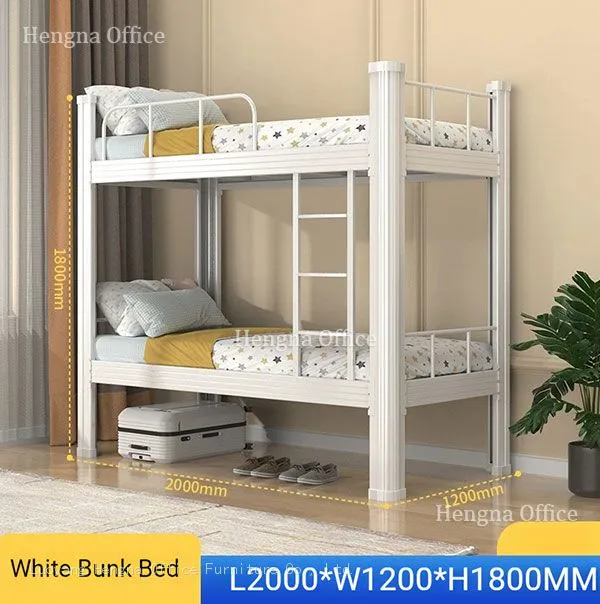
Scratch a powder-coated surface with a key: you get a shallow mark, not a peeled patch. The coating stays intact. That matters in a hostel where guests drag backpacks across the frame, or a dorm where furniture gets moved around every semester.
Cost difference: powder-coated beds run about $15 to $20 more per unit than painted ones. Over five years, you will not spend a dollar on touch-up paint or rust treatment. With painted beds, you will.
**Installation Time Is a Real Cost**
Here is a number that most buyers do not calculate: the labor cost of assembling a hundred beds.
Traditional bolt-together steel beds:
- One person assembles one bed in 40 to 50 minutes
- Requires a screwdriver, Allen wrench, sometimes a drill
- Small bolts and washers get lost, and you stop to search for them
- Two people needed to align frame sections
Quick-lock steel beds (no tools):
- One person assembles one bed in 15 minutes
- No tools required, everything clicks together
- All connectors are captured in the frame, nothing to lose
- One person can do the whole job
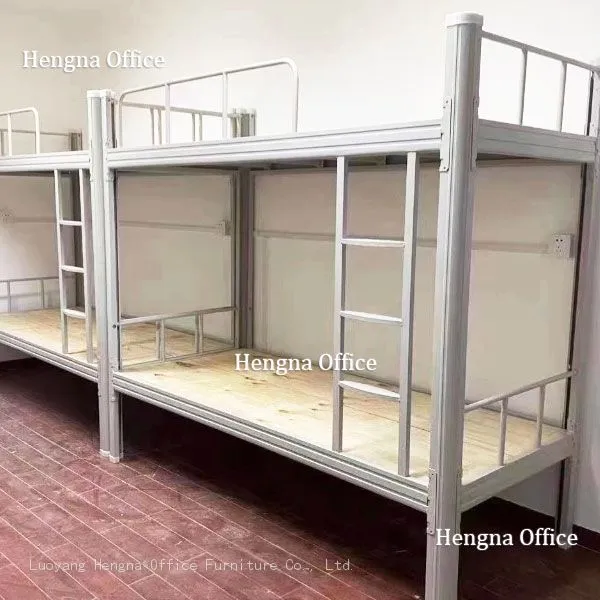
Apply that to a 100-bed order.
Traditional assembly: 2 people working 5 eight-hour days. Labor cost at $50 per person per day: $500 total.
Quick-lock assembly: 2 people working 1.5 days. Labor cost: $150.
You save $350 in labor on a single order. On a 200-bed order, it is $700. That covers the price difference between painted and powder-coated beds for the entire purchase.
For hostels, there is another angle. If you renovate between seasons, every day of construction is a day of lost revenue. Say you have 40 beds at $15 per night with 60 percent occupancy. One extra week of construction costs you $2,500 in missed bookings. The faster assembly directly saves you that.
**What Hostels Need vs. What Dorms Need**
They are both shared sleeping spaces, but the demands are different.
**For student dorms:**
- Same users for four years, heavy daily use
- Body weight varies, bigger students need a solid frame
- Maintenance staff is limited, so less is better
- Budget is fixed and approved in batches
The priority for dorms: durability first, zero maintenance, safety that does not require checking.
**For hostels:**
- New guests every night, different habits
- Backpacks and suitcases bang against the frame
- Guests judge the room by how clean and solid everything looks
- Housekeeping cleans fast, furniture needs to wipe down quickly
- Storage under the bed matters, guests do not want bags on the floor
The priority for hostels: easy to clean, looks decent with basic bedding, storage-friendly design.
Powder-coated steel works for both. The smooth surface wipes clean with a damp cloth. The color is consistent and matte, not shiny or cheap-looking. Paired with good bedding, it photographs well for hostel listings. And the under-bed clearance is enough for luggage or storage bins.
**The Five-Year Cost Per Bed Per Night**
This is the math that changes buying decisions.
Assume a bed is used 365 days per year and lasts five years before replacement.
Cheap wood bed: $55 purchase, $25 maintenance over five years (tightening, replacing boards). Total $80. Cost per bed per night: 4.4 cents.
Painted steel bed: $65 purchase, $20 maintenance over five years (touch-up paint, replacing rusted bolts). Total $85. Cost per bed per night: 4.7 cents.
Powder-coated steel bed: $80 purchase, essentially zero maintenance over five years. Total $80. Cost per bed per night: 4.4 cents.
The powder-coated bed costs more upfront but hits the same per-night cost as the cheapest option because it does not need repairs. And it looks better for all five years.
Extend that to ten years, and the gap widens further because the wood and painted beds need replacing after five years. The powder-coated bed does not.
**Common Mistakes Buyers Make**
**Mistake one: comparing unit price without checking shipping.**
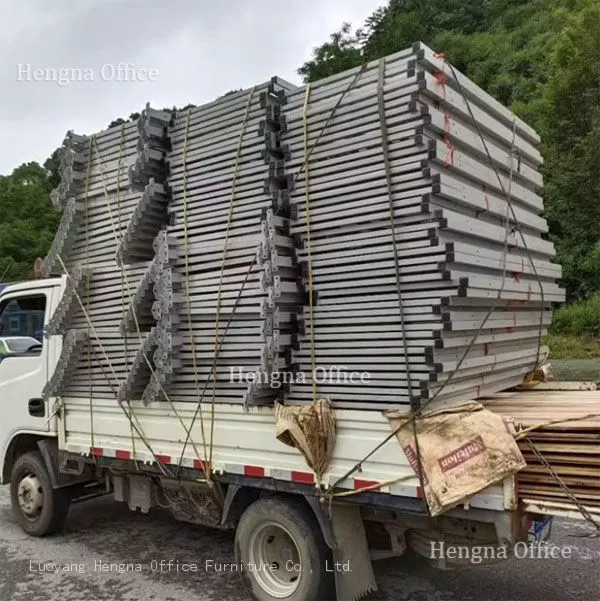
Some suppliers quote a low bed price then hit you with freight costs that exceed the product. Powder-coated beds stack flat and dense, so shipping cost per unit is lower than bulky wood beds. Always ask for delivered price, not FOB price.
**Mistake two: ordering bulk without inspecting a sample.**
It is tempting to save two bucks per unit by going with the cheapest quote. But cheap beds show their problems only after arrival: uneven coating, rough welds, sharp edges on the frame. By then, returns are expensive and the renovation timeline does not allow it.
Order one sample first. Assemble it yourself. Check the weld quality, the coating finish, the feel of the ladder and guardrails. If the sample is good, the bulk order will be good.
**Mistake three: overlooking the small specs.**
Guardrail height, ladder width, tube wall thickness, bed board thickness. These numbers are where manufacturers cut cost. A bed with 25cm guardrails is cheaper than one with 30cm guardrails, but the shorter guardrail is noticeably less safe for adults. A bed with 0.8mm wall tube is cheaper than 1.2mm, but it flexes and feels unstable.
Get the specs in writing. Do not assume.
**What to Pick for Different Scenarios**
Boutique hostel, design-focused: white or gray powder-coated steel beds with colored bedding. Costs less than wood, photographs just as well, cleans faster.
Chain hostel, multiple locations: standardize on powder-coated steel. Volume purchasing gets you a better price. Five-year replacement cycle means consistent look across properties.
University dormitory: powder-coated steel is the logical choice. No maintenance for four-year use cycles. No formaldehyde concerns like particle board beds. Safety specs are verifiable and consistent.
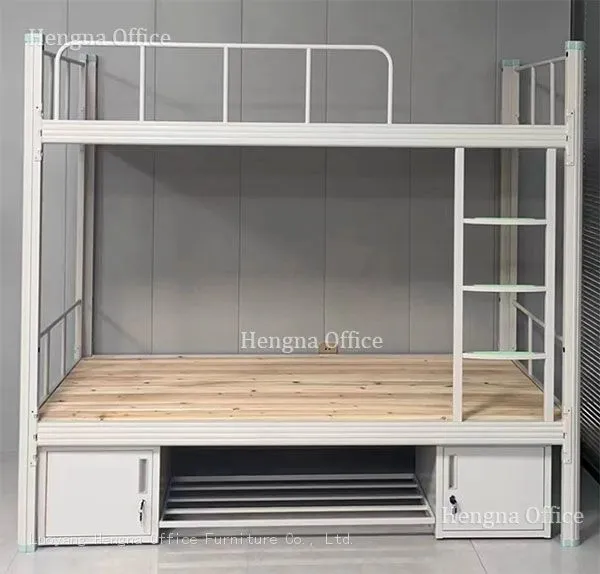
Company employee dormitory: go with heavy-gauge powder-coated steel. Employees come in all sizes, and the bed needs to handle rough daily use without showing wear.
Short-term construction camp: painted steel is acceptable here. The use period is short, and the bed will likely get abused anyway. No point paying for a long lifespan that will not be needed.
**Bottom Line**
The right bed is not the cheapest one on the invoice. It is the one that costs the least over the time you actually use it.
Powder-coated steel bunk beds cost $15 to $20 more per unit than painted steel. But between lower installation labor, zero maintenance, and longer lifespan, they are cheaper in total cost for anyone running accommodation for more than three years.
For hostel owners and student housing buyers, that is the number worth checking before you place the order.
Recently Posted
-
Welded vs Boltless Steel Shelving — Looks Strong at the Factory, Falls Apart at the Port
August 7, 2026Welded vs Boltless Steel Shelving — Looks Strong at the Factory, Falls Apart at the PortHere's a story every steel shelving im Read More
 -
You Asked a Steel Shelving Supplier for a Price. Here's What You Should Have Asked First.
August 7, 2026You found a steel shelving supplier. Their listing looks clean. You sent the message every first-time importer sends: "What&# Read More
 -
Heavy Duty Steel Workbench for Auto Repair — Cold Rolled Frame vs What Most Garages Use
August 5, 2026Mike has been running his independent garage for eleven years. Three bays, two mechanics, a steady stream of brake jobs and transm Read More
 -
Modular Workbench with Pegboard and Drawers — One Bench That Grows With Your Shop
August 5, 2026A shop starts with three people and two benches. Basic surface, no drawers, tools hanging on a pegboard nailed to the wall. Works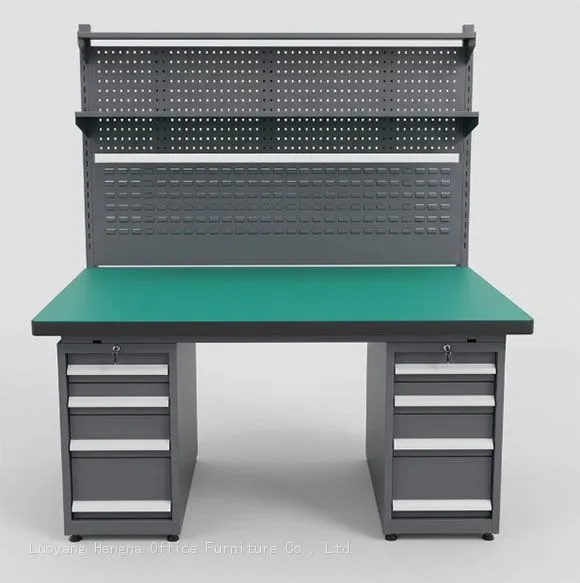 Read More

Contact Us
Recommended Products
-
 Industrial-Grade ABS Plastic Locker for Factory Staff and Warehouse Workers|Hengna OfficeUS$ 19 - 100MOQ: 5 Sets
 -
Outdoor ABS Locker Cabinet – UV-Resistant Plastic Storage for Poolside or Beach Resorts-Hengna OfficeUS$ 19 - 100MOQ: 5 Sets
-
45 Gallon Explosion-Proof Flammable Liquid Storage Cabinet – Fire-Resistant Steel Safety Cabinet for FactoriesUS$ 68 - 400MOQ: 2 Combos
-
Flammable Storage Cabinet for Flammable Liquids – OSHA Certified Safety Cabinet With Fireproof Double WallsUS$ 68 - 400MOQ: 2 Combos
-
Large Capacity Flammable Liquid Storage Cabinet – Explosion-Proof Safety Cabinet for Laboratory & Workshop UseUS$ 68 - 400MOQ: 2 Combos
-
Heavy Duty Steel Tool Cart With Drawers for Workshops|Hengna OfficeUS$ 99 - 269MOQ: 2 Cases
-
Wholesale 3-Drawer Tool Trolley With Wheels for Factory and Garage StorageUS$ 99 - 269MOQ: 2 Cases
-
HN-wlj160 Industrial Rolling Tool Organizer With Pegboard|All-in-One Mobile Tool Storage CartUS$ 5 - 120MOQ: 2 Cases
-
White Stackable Pathology Wax Block Storage Drawers for Labs Near London-Hengna OfficeNegotiableMOQ: 10 Pieces
-
Custom Paraffin Block Storage Cabinet for Histology Laboratories – Factory Direct From Hengna FurnitureNegotiableMOQ: 10 Pieces
-
Smart Phone Charging Locker 40-door|Fingerprint Lockers Intelligent Parcel Delivery CabinetUS$ 203 - 750MOQ: 15 Pieces
-
School Gym Lockers Price |Parcel Delivery Storage Locker 12-door FactoryUS$ 203 - 750MOQ: 15 Pieces
-
Multi Metal Work Benches Electrical Workshop Workbench|US$ 300 - 800MOQ: 2 Cases
-
Commercial Workbench Supplier |Multi Metal Work Bench With Drawers OMDUS$ 300 - 800MOQ: 2 Cases
-
Pathological Ection Cabinet JTGZ062 Wax Block Cabinet for LaboratoryNegotiableMOQ: 10 Pieces
-
Durable Tool Storage in Factory HNGJ703 Hard Wearing Metal Industrial Tool ChestNegotiableMOQ: 18 Pieces
-
High - Quality CNC Workshop Tool Cabinet Heavyweight Workshop Tool OrganizerNegotiableMOQ: 10 Pieces
-
Laboratory Polyethylene Acid and Corrosive Chemicals Safety Storage PP CabinetUS$ 340 - 600MOQ: 5 Combos
-
22 Gallons /80 L PP Acid - Base Cabinet: Safeguard Chemical Storage Supplier OEMUS$ 500 - 600MOQ: 5 Combos
-
4 - Gallon Corrosion-resistant Safety Cabinet for Hazardous Chemicals Acid SupplierUS$ 340 - 500MOQ: 5 Combos